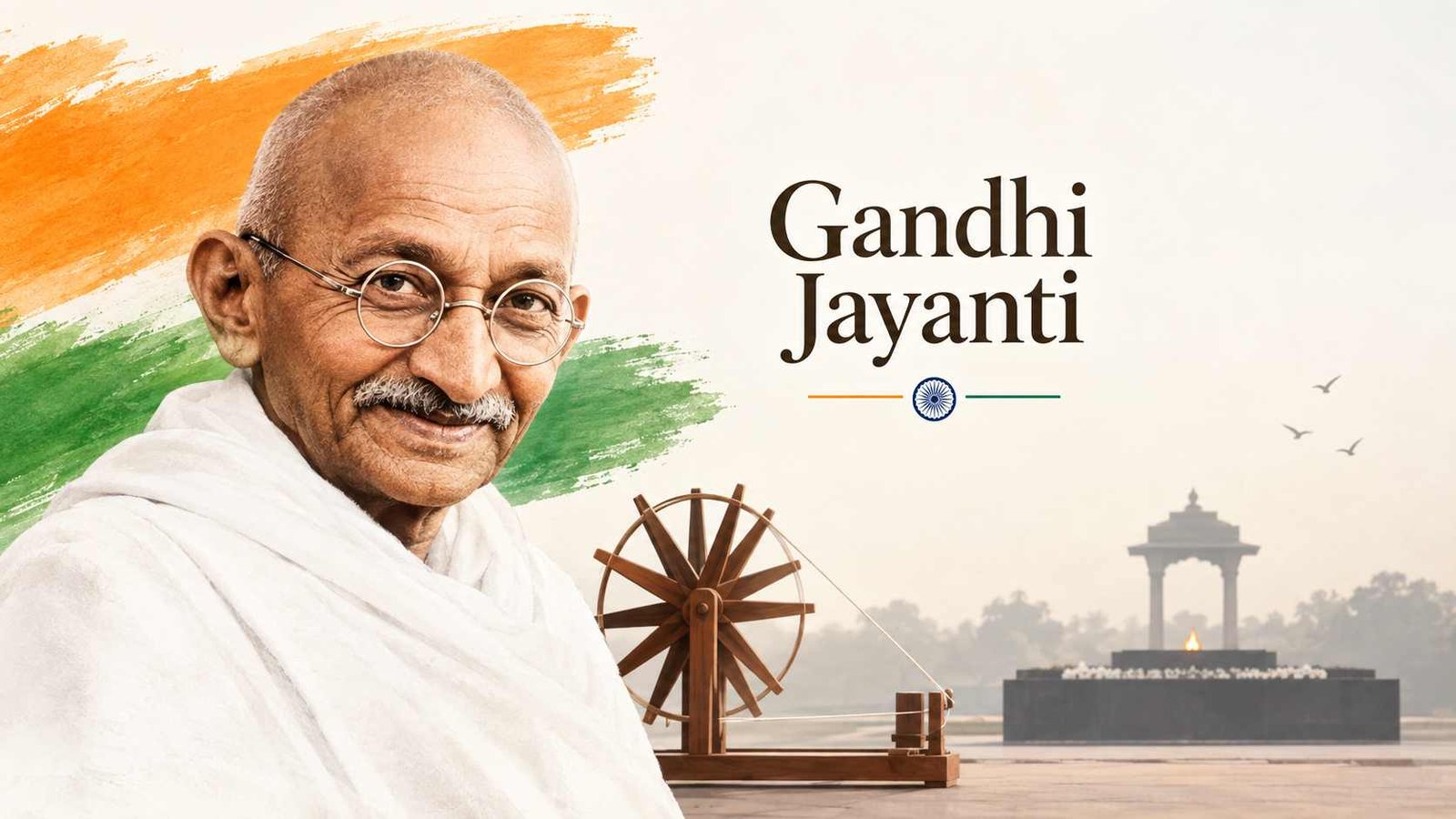
Gandhi Jayanti: History, Importance, Significance and the Life of Mahatma Gandhi
Gandhi Jayanti is one of the most important national occasions celebrated in India. Every year, on 2 October, people across the country commemorate the birth anniversary of Mohandas Karamchand Gandhi, popularly known as Mahatma Gandhi and the Father of the Nation. He was one of the most influential leaders of India's freedom movement and is remembered around the world for his philosophy of truth, non-violence, peace and justice.
Gandhi Jayanti is not just a day to remember the birth of a great leader. It is also an opportunity to reflect on the values that Mahatma Gandhi promoted throughout his life. His principles of Satya (truth), Ahinsa (non-violence), simplicity, equality and self-reliance continue to inspire people from different countries, cultures and generations.
India celebrates Gandhi Jayanti as a national holiday. Schools, colleges, government institutions, social organisations and communities organise various activities to honour his contributions. Prayer meetings, cleanliness drives, essay-writing competitions, cultural programmes and discussions about Gandhi's philosophy are common parts of the celebrations.
The United Nations has also recognised the importance of Gandhi's philosophy by observing 2 October as the International Day of Non-Violence. This recognition reflects the global relevance of his ideas and their continuing influence on movements for civil rights, freedom and social justice. Gandhi Jayanti reminds us that meaningful change does not always require violence or force. It can also be achieved through courage, truth, peaceful resistance and collective action. His life teaches us that individuals can make a significant difference when they remain committed to their principles.
When Is Gandhi Jayanti Celebrated?
Gandhi Jayanti is celebrated every year on 2 October to mark the birth anniversary of Mahatma Gandhi.
- Date: 2 October
- Occasion: Birth anniversary of Mahatma Gandhi
- Born: 2 October 1869
- Birthplace: Porbandar, Gujarat, India
- Full Name: Mohandas Karamchand Gandhi
- Popular Name: Mahatma Gandhi
- National Status: National holiday in India
- International Observance: International Day of Non-Violence
The day is observed throughout India, with commemorative events taking place at Gandhi memorials, public institutions and educational establishments. One of the most significant ceremonies is held at Raj Ghat in New Delhi, the memorial where Mahatma Gandhi was cremated. Gandhi Jayanti is a gazetted national holiday in India. Many government offices, schools and banks remain closed, although essential services continue to operate.
Who Was Mahatma Gandhi?
Mahatma Gandhi was an Indian lawyer, political leader, social reformer and advocate of non-violent resistance. He played a central role in India's struggle against British colonial rule and became an internationally recognised symbol of peaceful political resistance. He believed that truth and non-violence were powerful instruments for achieving social and political change. Rather than relying on armed rebellion, Gandhi encouraged people to challenge injustice through peaceful protests, civil disobedience, non-cooperation and personal sacrifice.
Gandhi's political activities were closely connected to his social beliefs.
He spoke against untouchability, promoted Hindu-Muslim unity, encouraged the use of locally made products and advocated for the empowerment of rural communities. He believed that India's freedom would be incomplete without social equality, economic self-reliance and respect for every individual. Although Gandhi is widely celebrated for his leadership in the independence movement, his political views, strategies and legacy have also been the subject of historical debate. Understanding his life includes recognising both his contributions and the criticisms of some of his ideas and actions. His influence extended far beyond India. Leaders and activists such as Martin Luther King Jr. and Nelson Mandela drew inspiration from aspects of Gandhi's approach to peaceful resistance.
Early Life and Childhood of Mahatma Gandhi
Mahatma Gandhi was born on 2 October 1869 in Porbandar, a coastal town in present-day Gujarat, India. His father, Karamchand Gandhi, served as a senior administrative official in the princely state of Porbandar. His mother, Putlibai, was deeply religious and played an important role in shaping his character. Gandhi grew up in a family where religious values, honesty, discipline and simplicity were important. His mother's devotion and commitment to religious practices influenced his understanding of morality, compassion and self-control.
As a child, Gandhi was quiet, shy and not particularly interested in public speaking. He attended primary school in Rajkot after his family moved there. He later continued his education at a high school in the same city. In 1883, at the age of 13, Gandhi married Kasturba Makhanji, who later became widely known as Kasturba Gandhi. Their marriage took place according to the customs of the time.
Gandhi's childhood was not marked by extraordinary achievements in academics or public life. However, his experiences during these early years helped shape the principles that later became central to his philosophy. He was particularly influenced by stories of truthfulness, sacrifice and moral courage. These values became important parts of his personal and political life.
Mahatma Gandhi's Education and Journey to London
In 1887, Gandhi passed his matriculation examination. He subsequently attended Samaldas College in Bhavnagar, although he did not continue his studies there for long. In 1888, Gandhi travelled to London, England, to study law. He enrolled at the Inner Temple, one of the professional institutions for legal education in London. Moving to a foreign country introduced Gandhi to a different culture, society and lifestyle. He faced challenges in adapting to English customs while attempting to maintain his family's religious and cultural values.
During his time in London, Gandhi studied law and developed an interest in different religious and philosophical traditions. He read works that influenced his thinking about morality, human behaviour, duty and non-violence. Gandhi completed his legal studies and was called to the bar in 1891. He returned to India that year and attempted to establish himself as a lawyer. However, his early legal career in India was not particularly successful. He struggled with public speaking and found it difficult to handle some aspects of courtroom practice. In 1893, Gandhi accepted a legal assignment in South Africa. This decision became a turning point in his life and eventually transformed him from a relatively unknown lawyer into a prominent political and social activist.
Mahatma Gandhi's Experience in South Africa
Gandhi travelled to South Africa in 1893 to work on a legal case for an Indian business organisation. During his time there, he experienced racial discrimination and witnessed the unequal treatment of Indian immigrants. One of the most well-known incidents occurred at Pietermaritzburg railway station. Gandhi held a valid first-class railway ticket but was ordered to leave the compartment because of his Indian identity. When he refused, he was forcibly removed from the train. This experience deeply affected Gandhi and influenced his decision to challenge racial discrimination. He began to understand that the discrimination he had personally experienced was part of a wider system of racial inequality affecting Indian communities in South Africa. Gandhi became involved in organising the Indian community and founded the Natal Indian Congress in 1894. The organisation sought to address discriminatory laws and protect the rights of Indians living in South Africa. During his years in South Africa, Gandhi developed the philosophy of Satyagraha, which means insistence on truth or holding firmly to truth. Satyagraha involved resisting injustice through peaceful methods, including non-cooperation, demonstrations and civil disobedience. Gandhi and his supporters organised campaigns against discriminatory policies. These activities sometimes resulted in arrests and imprisonment. His experiences in South Africa helped him develop the methods of non-violent resistance that he would later use in India's independence movement. Gandhi remained in South Africa for approximately 21 years, returning to India in 1915.
Mahatma Gandhi's Return to India in 1915
Gandhi returned to India on 9 January 1915 after spending many years in South Africa. His return marked the beginning of a new chapter in his public life. At the suggestion of political leader Gopal Krishna Gokhale, whom Gandhi regarded as an important mentor, he travelled throughout India to understand the country's social, economic and political conditions. India at that time was under British colonial rule. Large sections of the population faced poverty, economic hardship, social discrimination and restrictions on political freedom. Gandhi believed that he needed to understand the lives of ordinary Indians before leading a national movement. He established an ashram near Ahmedabad, where he and his followers practised simple living, self-discipline, community service and manual labour. Gandhi gradually became involved in local struggles concerning farmers, workers and other communities experiencing injustice. His ability to communicate with ordinary people and his commitment to peaceful resistance helped him become an increasingly prominent figure in Indian politics.
Gandhi's Role in India's Freedom Struggle
Mahatma Gandhi played a significant role in India's struggle for independence from British rule. He helped transform the independence movement into a mass political campaign involving people from different regions, occupations and social backgrounds. Before Gandhi's rise to national prominence, India's freedom movement included several approaches, such as constitutional reforms, political negotiations, revolutionary activities and public protests. Gandhi introduced and expanded the use of mass non-violent resistance as a central method of political mobilisation. His approach encouraged people to participate in peaceful demonstrations, refuse cooperation with unjust laws, boycott certain British goods and support Indian-made products.
Some of the most significant movements associated with Gandhi include:
- Champaran Satyagraha (1917)
- Kheda Satyagraha (1918)
- Ahmedabad Mill Workers' Strike (1918)
- Non-Cooperation Movement (1920–1922)
- Civil Disobedience Movement (1930)
- Quit India Movement (1942)
These movements addressed different political, economic and social issues. They also helped broaden public participation in the struggle against colonial rule.
Champaran Satyagraha (1917)
The Champaran Satyagraha was one of Gandhi's first major movements in India. Champaran, located in present-day Bihar, was an important agricultural region where many farmers were compelled by the colonial-era plantation system to cultivate indigo under exploitative conditions. Farmers faced economic difficulties and complained about unfair practices imposed by European indigo planters. In 1917, Gandhi visited Champaran after being requested to help the affected farmers. He investigated their complaints and organised a peaceful campaign to demand reforms. British authorities ordered Gandhi to leave the district, but he refused to comply. He was subsequently required to appear in court, where his actions attracted significant public attention. The campaign led to an official inquiry and reforms addressing some of the grievances of the farmers. The Champaran Satyagraha established Gandhi as an important leader in India's political landscape and demonstrated how organised peaceful resistance could be used to challenge injustice.
Kheda Satyagraha (1918)
The Kheda Satyagraha took place in Gujarat in 1918. Farmers in the region were experiencing severe economic difficulties because of crop failure, disease and poor agricultural conditions. Despite the hardships, farmers were still expected to pay land revenue to the colonial administration. Gandhi, along with local leaders such as Sardar Vallabhbhai Patel, supported the farmers' demand for revenue relief. The movement encouraged farmers to peacefully withhold payment of land revenue until their grievances were addressed. The campaign brought attention to the financial problems faced by rural communities and helped establish cooperation between Gandhi and other leaders of the independence movement.
Ahmedabad Mill Workers' Strike (1918)
In 1918, Gandhi supported textile mill workers in Ahmedabad who were demanding improved wages. There was a dispute between mill owners and workers over wage increases. Gandhi encouraged workers to organise peacefully and maintain discipline during the strike. He used fasting as a form of personal moral appeal during the dispute. The conflict was eventually resolved through an agreement that included a wage increase for the workers. The Ahmedabad movement demonstrated Gandhi's interest in labour rights and his belief in peaceful negotiation between employers and employees.
Non-Cooperation Movement (1920–1922)
The Non-Cooperation Movement was one of the first large-scale national movements associated with Gandhi. It was launched in 1920 in response to British colonial policies, including the Rowlatt Act and the events surrounding the Jallianwala Bagh massacre of 1919. Gandhi also supported the Khilafat movement, which had mobilised many Indian Muslims. The movement called on Indians to withdraw cooperation from British institutions and colonial administration through peaceful means.
Its activities included:
- Boycotting certain British goods.
- Encouraging the use of Khadi and Indian-made products.
- Leaving government-supported educational institutions.
- Resigning from selected government positions.
- Promoting peaceful public demonstrations.
- Encouraging national education and self-reliance.
The movement attracted participation from students, workers, farmers, traders and other sections of society. However, in February 1922, violence broke out at Chauri Chaura in present-day Uttar Pradesh, where a police station was set on fire and police personnel were killed. Gandhi believed that the movement had moved away from the principle of non-violence. He therefore decided to suspend the Non-Cooperation Movement. His decision was controversial among some national leaders, who disagreed with ending a movement that had gained considerable momentum. The episode illustrates Gandhi's insistence that non-violence was not simply a political tactic but a fundamental principle of his approach to political struggle.
Dandi March and Salt Satyagraha (1930)
The Dandi March, also known as the Salt March, was one of the most recognised events in India's freedom struggle. In March 1930, Gandhi began a march from Sabarmati Ashram near Ahmedabad to the coastal village of Dandi in Gujarat. He was accompanied by a group of selected volunteers, and the march attracted increasing public attention along the way. The march covered approximately 240 miles (around 385 kilometres) over several weeks. The central issue was the British salt tax and the colonial government's monopoly over salt production and sale. Salt was an essential commodity used by people across all economic groups, making the issue particularly significant. On 6 April 1930, Gandhi reached Dandi and broke the salt law by making salt from seawater. This act of civil disobedience inspired people across India to challenge the colonial salt laws and participate in peaceful protests. The Salt Satyagraha attracted international media attention and became a major event in the Indian independence movement.
The movement was followed by widespread arrests, including Gandhi's imprisonment. It also contributed to negotiations between Indian political leaders and the British government, including the Gandhi-Irwin Pact of 1931. The Dandi March remains an important example of how a simple everyday commodity became the focus of a large political movement.
Quit India Movement (1942)
The Quit India Movement was launched in August 1942 during the Second World War. The Indian National Congress demanded an end to British rule in India. Gandhi called on the British to leave the country and urged Indians to pursue independence. On 8 August 1942, the Congress passed the Quit India resolution in Bombay, now Mumbai. Gandhi delivered his famous call of "Do or Die", urging Indians to remain committed to the struggle for freedom. The British colonial administration responded by arresting Gandhi and several other Congress leaders. Gandhi was detained at the Aga Khan Palace in Pune. Despite the arrest of prominent leaders, protests spread across different parts of India. The movement included demonstrations, strikes and acts of civil disobedience, although some protests also involved violence and damage to public infrastructure. The Quit India Movement became an important phase of the independence struggle and reflected the widespread demand for an end to colonial rule. India ultimately gained independence on 15 August 1947, following years of political mobilisation, negotiations, resistance and developments within the British Empire. Gandhi's leadership was a major part of this wider historical process.
The Philosophy of Mahatma Gandhi
Mahatma Gandhi's philosophy was based on truth, non-violence, simplicity, self-discipline and service to humanity. These principles guided his personal life, social activities and political movements. His ideas were not limited to India's independence. He believed that individuals and societies could build a more peaceful and just world by practising ethical behaviour and respecting others.
Truth (Satya)
Truth was one of the most important principles in Gandhi's life. He believed that people should be honest in their words, actions and decisions. For Gandhi, truth was not merely about avoiding lies. It also meant being sincere, accepting mistakes and consistently trying to do what was morally right. He believed that truth should guide political leadership, social relationships and personal conduct. His autobiography, The Story of My Experiments with Truth, describes many of his personal experiences, struggles and attempts to live according to his principles.
Non-Violence (Ahinsa)
Non-violence was the foundation of Gandhi's political philosophy. He believed that injustice should be resisted without hatred or physical violence. According to his philosophy, peaceful resistance required courage, patience, discipline and a willingness to accept personal suffering rather than inflict it on others. Gandhi's concept of Ahinsa extended beyond physical violence to include avoiding hatred and cruelty in one's thoughts, words and actions. His approach influenced several international movements for civil rights and social change. The United Nations recognises non-violence as a principle with universal relevance.
Satyagraha
Satyagraha is a term closely associated with Gandhi. It combines the ideas of truth and firm commitment. Gandhi developed Satyagraha as a method of challenging injustice through non-violent resistance. It involved peaceful demonstrations, civil disobedience, non-cooperation and a commitment to maintaining moral discipline even when facing opposition. Satyagraha was intended not merely to defeat an opponent but also to appeal to their conscience and encourage a just resolution.
Swadeshi and Self-Reliance
Gandhi strongly supported Swadeshi, which encouraged people to use locally produced goods and strengthen domestic industries. He promoted Khadi, hand-spun and handwoven cloth, as a symbol of economic independence and resistance to colonial economic structures. The spinning wheel, or Charkha, became an important symbol of his philosophy. Gandhi believed that India's economic progress should include rural communities, small-scale industries and opportunities for people to support themselves.
Simplicity and Self-Discipline
Gandhi believed that people should live simply and avoid unnecessary material consumption. He wore simple Khadi clothing, practised a disciplined daily routine and encouraged manual labour. His lifestyle reflected his belief that personal behaviour should be consistent with the principles one promotes publicly. He also emphasised self-control, honesty and responsibility as essential qualities for individuals seeking social change.
Equality and Social Justice
Gandhi campaigned against untouchability and worked to improve the social conditions of communities facing discrimination. He advocated dignity, access to public facilities and greater social inclusion. However, his approach to caste and the political representation of oppressed communities has been strongly debated, particularly by B. R. Ambedkar, who argued for structural changes and independent political safeguards for Dalits. Understanding Gandhi's legacy requires recognising both his campaigns against untouchability and the differences between his views and those of other social reformers
Why Is Gandhi Jayanti Celebrated?
Gandhi Jayanti is celebrated to honour Mahatma Gandhi's birth and remember his contributions to India's independence movement and social reform. The day also provides an opportunity to reflect on the values he promoted and their relevance to modern society.
Some of the key reasons for celebrating Gandhi Jayanti include:
- Remembering India's freedom struggle: Gandhi's leadership helped mobilise millions of Indians against colonial rule.
- Promoting non-violence: The day highlights peaceful approaches to resolving disputes and resisting injustice.
- Encouraging truthfulness: Gandhi's commitment to truth reminds people of the importance of honesty and integrity.
- Promoting equality: His campaigns against untouchability and discrimination remain part of the discussion about social justice.
- Encouraging self-reliance: His ideas about Khadi, local production and rural development continue to be studied.
- Inspiring community service: Gandhi Jayanti encourages people to contribute to their communities through constructive activities.
The occasion is therefore both a remembrance of the past and a time to consider how these principles can be applied in everyday life.
How Is Gandhi Jayanti Celebrated in India?
Gandhi Jayanti is observed across India through official ceremonies, educational programmes, cultural events and community activities.
Prayer Meetings at Raj Ghat
One of the most significant Gandhi Jayanti ceremonies takes place at Raj Ghat, the memorial of Mahatma Gandhi in New Delhi. Government representatives, political leaders and visitors pay floral tributes and participate in commemorative activities. Prayer meetings and moments of silence are organised to remember Gandhi's life and contributions.
Celebrations in Schools and Colleges
Schools and colleges organise special programmes to educate students about Gandhi's life, philosophy and role in the independence movement.
Common activities include:
- Essay-writing competitions
- Speech and debate competitions.
- Drawing and poster-making contests.
- Patriotic songs and cultural performances.
- Quiz competitions about India's freedom struggle.
- Plays depicting important events from Gandhi's life.
These activities help students learn about India's history and understand the significance of truth, peace and social responsibility.
Cleanliness Drives
Cleanliness and sanitation were important parts of Gandhi's vision for society. On Gandhi Jayanti, schools, government departments, voluntary organisations and local communities often organise cleanliness drives. People participate in cleaning public spaces, parks, streets, schools and neighbourhoods. The day is also associated with the Swachh Bharat Abhiyan, which was launched on 2 October 2014 to promote sanitation and cleanliness across India. These activities connect Gandhi's emphasis on personal responsibility and community service with modern public cleanliness efforts.
Promotion of Khadi and Village Industries
Gandhi promoted Khadi and village industries as part of his vision for economic self-reliance. Gandhi Jayanti is an occasion when exhibitions, fairs and promotional activities may be organised to showcase Khadi, handicrafts and products made by local artisans. Such events highlight the role of traditional skills and small-scale production in rural livelihoods.
Cultural and Social Programmes
Many communities organise cultural events that focus on Gandhi's life and the independence movement. These may include documentary screenings, historical exhibitions, discussions, poetry recitations and theatrical performances. Social organisations may also arrange blood donation camps, charity activities, educational initiatives and visits to community centres.
Tribute at Gandhi Memorials
Apart from Raj Ghat, people visit other places associated with Gandhi, including Gandhi Smriti in New Delhi and Sabarmati Ashram in Ahmedabad. These places preserve historical objects, documents, photographs and memories associated with his life. Visitors learn about the events that shaped Gandhi's political and social philosophy.
International Day of Non-Violence
Gandhi Jayanti is also observed internationally as the International Day of Non-Violence. On 15 June 2007, the United Nations General Assembly adopted Resolution A/RES/61/271, establishing 2 October as the International Day of Non-Violence. The observance aims to promote the message of non-violence through education, public awareness, peacebuilding and dialogue. The day recognises Gandhi's contribution to the philosophy and practice of non-violent resistance and highlights the relevance of peaceful approaches to social and political challenges. Countries and organisations around the world observe the day through educational events, peace campaigns, discussions and activities promoting tolerance and mutual understanding. Gandhi's philosophy has influenced several internationally recognised figures and movements. Martin Luther King Jr. studied Gandhi's approach to non-violent resistance and applied aspects of it during the American civil rights movement. Nelson Mandela also acknowledged the influence of Gandhi's resistance methods in the struggle against apartheid in South Africa, while developing his own political approach in a very different historical context.
The international observance of 2 October demonstrates how a leader associated with India's freedom struggle became a globally recognised figure in discussions about peace and non-violent resistance.
Famous Quotes of Mahatma Gandhi
Mahatma Gandhi's writings and speeches contain many statements about truth, peace, justice, self-discipline and humanity.
Some well-known quotations associated with his philosophy include:
- My life is my message.
- The future depends on what you do today.
- An eye for an eye only ends up making the whole world blind.
- Non-violence is a weapon of the strong.
- The best way to find yourself is to lose yourself in the service of others.
These quotations are widely circulated, although the wording and attribution of some popular Gandhi quotes can vary between sources. For formal academic or historical use, it is advisable to verify quotations against his published writings or speeches. His philosophy emphasised that meaningful social change begins with personal responsibility and that the pursuit of justice should be consistent with ethical principles.
The Importance of Gandhi Jayanti in Modern Society
Gandhi Jayanti remains relevant because many of the challenges Gandhi addressed continue to affect societies around the world.
Peace and Conflict Resolution
Conflicts can arise between individuals, communities and nations because of differences in political beliefs, cultural traditions, economic interests and social identities. Gandhi's philosophy encourages dialogue, peaceful protest and non-violent methods of resolving disagreements. His approach provides one framework for considering how people can challenge injustice while seeking to reduce physical harm.
Fighting Discrimination
Discrimination based on caste, economic status, language, religion and other social differences remains an issue in many societies. Gandhi Jayanti provides an opportunity to discuss equality, dignity and the importance of treating people fairly. It also encourages reflection on the different approaches taken by historical reformers to address social inequalities.
Honesty and Integrity
Truthfulness and integrity are important in personal relationships, education, business and public life. Gandhi's emphasis on honesty encourages people to take responsibility for their actions, acknowledge mistakes and act ethically. These values can help build trust between individuals and within communities.
Environmental Responsibility
Gandhi's advocacy of simple living, limited consumption and self-restraint is often connected to modern discussions about environmental sustainability. His views can encourage people to consider the environmental consequences of their consumption habits, waste generation and use of natural resources. Although Gandhi did not develop a modern environmental policy framework, aspects of his philosophy are relevant to conversations about sustainable lifestyles.
Community Service
Gandhi believed that serving others was an important part of living a meaningful life. Gandhi Jayanti can inspire people to participate in community activities, support disadvantaged groups, improve public spaces and contribute to education and social welfare. Small acts of service can help build cooperation and responsibility within society
Mahatma Gandhi's Death and Legacy
Mahatma Gandhi was assassinated on 30 January 1948 in New Delhi by Nathuram Godse, a Hindu nationalist who opposed Gandhi's efforts towards communal harmony and his approach to relations between Hindus and Muslims. Gandhi was 78 years old at the time of his death.
His assassination occurred only months after India achieved independence and during a period of intense communal tensions and displacement following Partition. His death caused widespread grief in India and around the world. Gandhi's body was cremated in New Delhi, and Raj Ghat was subsequently developed as his memorial. His legacy continues to be discussed in India and internationally. He is remembered for his role in the independence movement, his methods of peaceful resistance and his influence on movements for civil rights and social change.
At the same time, historians and social thinkers continue to examine his views on caste, race, gender, political strategy and other aspects of his life. These discussions form an important part of understanding the complexity of his historical legacy.
Gandhi Jayanti and the Swachh Bharat Abhiyan
The Swachh Bharat Abhiyan, or Clean India Mission, was launched by the Government of India on 2 October 2014, the birth anniversary of Mahatma Gandhi. The campaign aims to improve sanitation, reduce open defecation, encourage proper waste management and promote cleanliness as a shared responsibility. Gandhi had frequently spoken about the importance of sanitation and hygiene. He considered cleanliness essential to a healthy and dignified society. The Swachh Bharat Abhiyan uses 2 October as a significant date to connect contemporary cleanliness initiatives with Gandhi's emphasis on sanitation and community responsibility. The campaign also highlights the importance of public participation, local administration and individual contributions to maintaining clean surroundings.
Interesting Facts About Mahatma Gandhi
- Mahatma Gandhi was born on 2 October 1869 in Porbandar, Gujarat.
- His full name was Mohandas Karamchand Gandhi.
- His father's name was Karamchand Gandhi and his mother's name was Putlibai.
- He married Kasturba Gandhi in 1883.
- He travelled to London in 1888 to study law.
- He went to South Africa in 1893 to work as a lawyer.
- He developed his philosophy of Satyagraha during his time in South Africa.
- He returned to India in 1915.
- The Champaran Satyagraha of 1917 was one of his first major political campaigns in India.
- He led the historic Dandi March in 1930 to protest the British salt laws.
- He launched the Quit India Movement alongside the Indian National Congress in 1942.
- He was assassinated on 30 January 1948.
- His birthday is observed as the International Day of Non-Violence by the United Nations.
- His autobiography is titled The Story of My Experiments with Truth.
- He promoted Khadi, village industries, simplicity and self-reliance.
Frequently Asked Questions About Gandhi Jayanti
Why is Gandhi Jayanti celebrated on 2 October?
Gandhi Jayanti is celebrated on 2 October because Mahatma Gandhi was born on this date in 1869 in Porbandar, Gujarat. India commemorates his birth anniversary as a national holiday.
Who is known as the Father of the Nation in India?
Mahatma Gandhi is popularly known as the Father of the Nation in India because of his major role in the freedom struggle and his influence on the country's independence movement.
Is Gandhi Jayanti a national holiday in India?
Yes. Gandhi Jayanti is a national holiday in India. Government offices, schools and many other institutions generally remain closed on this day.
What is the importance of Gandhi Jayanti?
Gandhi Jayanti honours Mahatma Gandhi's contributions to India's independence movement and his philosophy of truth, non-violence, equality and peace. It also encourages people to reflect on social responsibility and community service.
What is the International Day of Non-Violence?
The International Day of Non-Violence is observed globally on 2 October, the birth anniversary of Mahatma Gandhi. It was established by a United Nations General Assembly resolution in 2007 to promote non-violence through education and public awareness.
What was Mahatma Gandhi's role in India's independence?
Gandhi helped organise mass movements against British colonial rule, including the Non-Cooperation Movement, Civil Disobedience Movement and Quit India Movement. His approach relied heavily on non-violent resistance and public participation.
What is the meaning of Satyagraha?
Satyagraha means holding firmly to truth. It is Gandhi's philosophy of resisting injustice through non-violent methods such as peaceful protest, civil disobedience and non-cooperation.
How do schools celebrate Gandhi Jayanti?
Schools commonly organise special assemblies, speeches, essay competitions, cultural performances, quizzes, cleanliness drives and activities about Gandhi's life and philosophy.
Where is Mahatma Gandhi's memorial located?
Raj Ghat in New Delhi is the memorial of Mahatma Gandhi. It is the site where his last rites were performed and is an important location for Gandhi Jayanti ceremonies.
What is the message of Gandhi Jayanti?
The central message of Gandhi Jayanti is to promote truth, non-violence, peace, equality, simplicity and service to humanity. It encourages people to work towards a society based on mutual respect and justice.
Conclusion
Gandhi Jayanti is an important occasion for India and the international community to remember Mahatma Gandhi's life, contributions and philosophy. Born on 2 October 1869, Gandhi became a central figure in India's independence movement and helped popularise non-violent resistance as a method of challenging colonial rule. His campaigns, including the Champaran Satyagraha, Dandi March and Quit India Movement, remain significant events in Indian history. His principles of truth, non-violence, simplicity, self-reliance and social service continue to be discussed in the context of modern challenges, including discrimination, conflict, inequality and environmental responsibility. Gandhi Jayanti is more than a historical commemoration. It is an opportunity for individuals, communities and institutions to reflect on the role of ethical conduct, peaceful dialogue and social responsibility in everyday life. By remembering Gandhi's achievements as well as examining the debates surrounding his legacy, people can develop a deeper understanding of India's freedom struggle and the continuing importance of peace and justice. The true significance of Gandhi Jayanti lies not only in remembering Mahatma Gandhi but also in reflecting on how the values he promoted can be practised in our daily lives