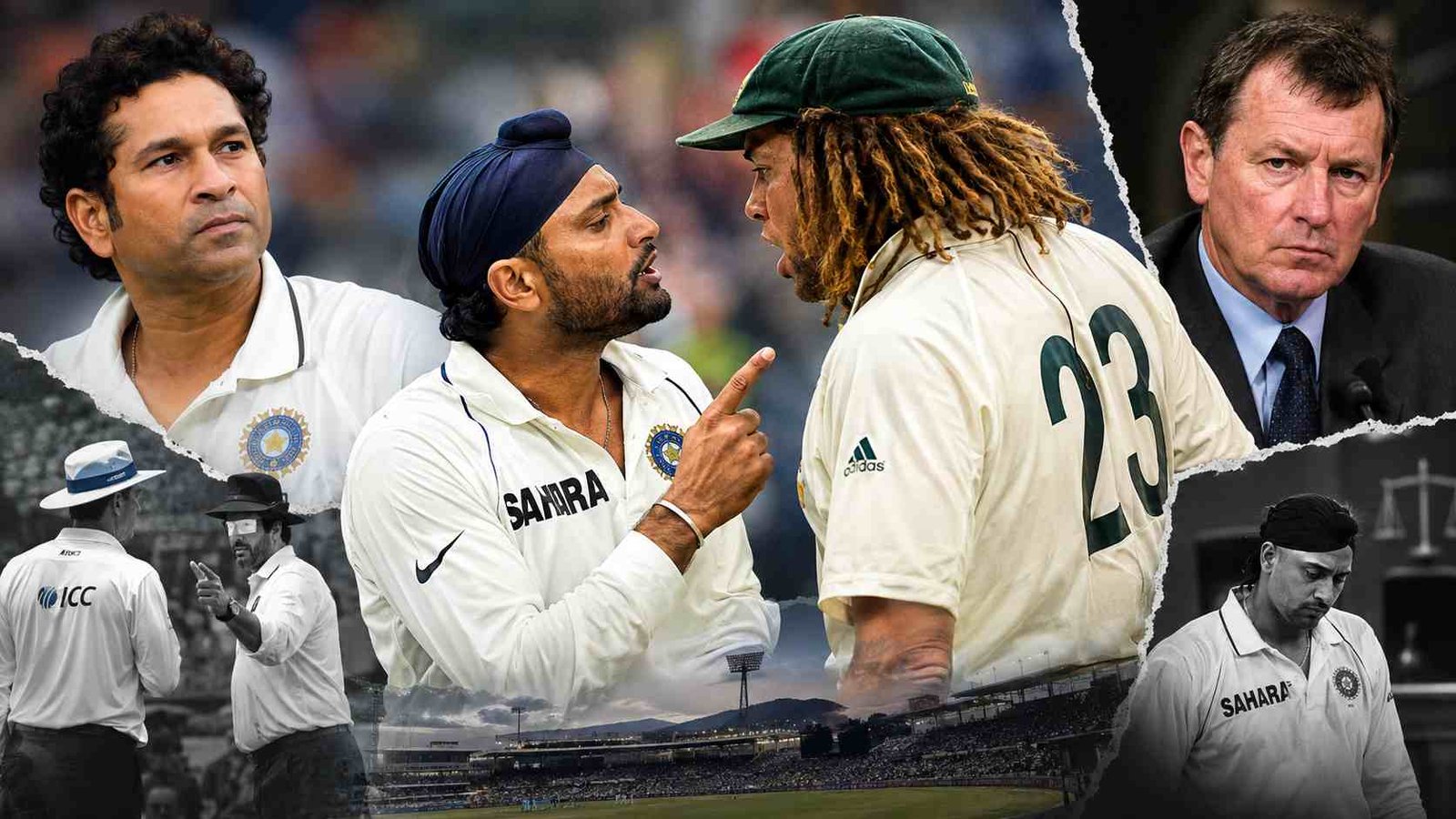
The Monkeygate Scandal: The Complete Story of the Controversy Between Harbhajan Singh and Andrew Symonds
The history of cricket is filled with controversies that have shaken the sporting world. However, one incident in 2008 between India and Australia took cricket beyond the boundaries of the game and turned it into a major debate about racial discrimination, poor umpiring, sportsmanship and player conduct. This controversy is famously known as the Monkeygate Scandal.
Imagine losing the first Test match by a massive margin of 337 runs. In the very next match, your team is already frustrated by several controversial umpiring decisions. The players are under pressure, tempers are rising on the field, and suddenly one of your team's key players gets involved in a heated argument with a legendary opposition cricketer.
Within minutes, an ordinary on-field argument turns into a serious allegation of racial abuse.
That is exactly what happened during the 2008 Sydney Test between India and Australia, when Indian off-spinner Harbhajan Singh and Australian all-rounder Andrew Symonds became involved in a heated confrontation.
Australian players accused Harbhajan Singh of calling Andrew Symonds a "monkey", which was considered a racial insult. The incident quickly escalated into an international controversy, resulting in Harbhajan initially receiving a three-Test suspension.
However, following an appeal and a formal hearing, Harbhajan was cleared of the racial abuse charge, although a lesser charge of using abusive language remained.
But several questions still surround the incident.
Did Harbhajan Singh really make a racial remark against Andrew Symonds? Was the controversy a result of the mounting frustration caused by controversial umpiring? And how did a disagreement between two cricketers become one of the biggest controversies in international cricket?
Let's explore the complete story of the 2008 Monkeygate Scandal.
The Beginning of the Monkeygate Scandal: India vs Australia, 2008
In the 2007–08 season, the Indian cricket team toured Australia for a four-match Test series. The Indian team was led by Anil Kumble, while Ricky Ponting captained the Australian side.
The series began with the first Test at the Melbourne Cricket Ground, where Australia delivered a dominant performance and defeated India by 337 runs.
It was a disappointing defeat for the Indian team, which was determined to make a strong comeback in the second Test at the Sydney Cricket Ground (SCG).
However, the Sydney Test soon became controversial because of several questionable umpiring decisions. Indian players were visibly frustrated, and the atmosphere on the field became increasingly tense.
Although the match featured outstanding performances from some of the world's best cricketers, it is remembered primarily for the controversy involving Harbhajan Singh and Andrew Symonds.
The incident eventually became known as the Monkeygate Scandal and attracted widespread attention from cricket fans, media organisations and sporting authorities around the world.
The Sydney Test Match: What Happened?
The second Test of the series was played at the Sydney Cricket Ground in January 2008. Australia won the toss and elected to bat first.
The Australian batting lineup performed impressively, scoring 463 runs in the first innings. India responded with an even stronger batting performance.
Sachin Tendulkar scored an outstanding century, while VVS Laxman also produced a brilliant hundred. Sourav Ganguly contributed a valuable half-century, helping India establish a first-innings lead.
India eventually scored 532 runs, taking a 69-run lead over Australia.
In the second innings, Australia fought back strongly and scored 401 runs for seven wickets before declaring. This gave India a challenging target of 333 runs to win the match.
Unfortunately, the Indian batting lineup failed to withstand the Australian bowling attack. India were bowled out for just 210 runs, handing Australia a 122-run victory.
Despite Australia's victory, the match became infamous for the controversial umpiring decisions and the heated exchanges between players.
Many Indian fans and former cricketers believed that several umpiring decisions had gone against India. These incidents contributed to growing frustration within the Indian camp.
The situation eventually reached a boiling point when Harbhajan Singh and Andrew Symonds became involved in an argument during India's first innings.
Controversial Umpiring Increased Tensions
The Sydney Test is widely remembered as one of the most controversial matches in Test cricket, particularly because of the umpiring decisions made during the game.
Several decisions involving both teams attracted criticism, with the Indian players particularly unhappy about some of the calls made by the on-field umpires.
One of the most debated incidents involved Sourav Ganguly's dismissal, which was questioned by the Indian camp.
The Indian team felt that certain decisions had significantly affected the course of the match. The frustration was evident among the players, and the atmosphere became increasingly aggressive.
At the same time, Australia were determined to maintain their advantage in the series. The competitive intensity between the two sides was already high, and the controversial decisions only added to the pressure.
In such an environment, even a minor disagreement between players could quickly escalate into a serious confrontation.
That is precisely what happened between Harbhajan Singh and Andrew Symonds.
Harbhajan Singh vs Andrew Symonds: The Heated On-Field Argument
The incident occurred during India's first innings when the team had reached 451 runs for the loss of seven wickets.
Harbhajan Singh was batting alongside the Indian lower order, while Australian fast bowler Brett Lee was bowling.
After defending a delivery, Harbhajan moved towards the other end of the pitch. During this moment, he began exchanging words with Australian all-rounder Andrew Symonds.
Initially, the conversation appeared to be a normal exchange between two competitive cricketers. However, the discussion soon became heated, and both players began arguing.
The confrontation attracted the attention of the players on the field, and the situation briefly threatened to escalate further.
Although the argument eventually subsided and the match continued, the incident had already created considerable tension.
The Australian players subsequently complained to the umpires, alleging that Harbhajan Singh had used the word "monkey" to insult Andrew Symonds.
According to the Australian team, the alleged remark was not simply an ordinary insult but a racial slur directed at Symonds because of his ethnic background.
Andrew Symonds, who had a mixed ethnic heritage, considered the alleged comment deeply offensive.
Harbhajan Singh, however, denied the allegation and maintained that he had not made any racial remark against Symonds.
This disagreement transformed an on-field argument into an international controversy that would dominate cricket headlines for months.
What Did Sachin Tendulkar Witness?
Sachin Tendulkar played an important role in the Monkeygate controversy because he was present on the field when the incident occurred.
At the time of the argument, Tendulkar was batting at the other end and was among the key witnesses to the exchange between Harbhajan Singh and Andrew Symonds.
During the subsequent hearing, Sachin Tendulkar supported Harbhajan Singh and gave evidence in his favour.
According to Tendulkar, the words he heard during the confrontation did not support the allegation that Harbhajan had made a racial remark.
He explained that the Australians may have misunderstood the words used by Harbhajan and that the alleged racial insult had not been directed at Symonds in the manner claimed.
The Australian team, however, stood by its allegations. Captain Ricky Ponting and other players maintained that Harbhajan had used a racial slur.
This created a major disagreement between the two teams, with Sachin Tendulkar's testimony becoming a significant part of the case.
The incident also highlighted how the interpretation of words, particularly in a heated sporting environment, can have serious consequences.
The Australian Team's Reaction to the Allegations
Following the incident, the Australian players approached the umpires and formally complained about Harbhajan Singh's alleged remarks.
Ricky Ponting, Matthew Hayden and other Australian players supported Andrew Symonds and insisted that the incident should be treated as a serious case of racial abuse.
The Australian camp believed that the alleged comment had crossed the boundaries of acceptable behaviour and demanded disciplinary action.
The Indian team, meanwhile, strongly rejected the allegations and defended Harbhajan Singh.
The disagreement extended beyond the players and created tension between the two cricket boards.
The situation became even more complicated when the allegations resulted in a disciplinary hearing immediately after the Test match.
ICC Match Referee Mike Procter's Decision
Following the conclusion of the Sydney Test, the matter was referred to match referee Mike Procter.
A disciplinary hearing was conducted to examine the allegations made against Harbhajan Singh.
After approximately four hours of proceedings, Mike Procter found Harbhajan guilty of a Level 3 offence under the ICC Code of Conduct.
The referee concluded that Harbhajan had directed the alleged racial remark at Andrew Symonds and that the comment was intended to offend him on the basis of his race or ethnic origin.
As a result, Harbhajan Singh was handed a three-Test suspension.
The decision came as a major shock to the Indian team, as Harbhajan was one of the country's most important spin bowlers.
Losing a key player for three Test matches could have seriously affected India's chances in the remaining matches of the series.
The Indian team management strongly disagreed with the decision and considered the punishment unfair.
India appealed against the ruling and even raised the possibility of withdrawing from the tour if the matter was not resolved satisfactorily.
The controversy had now become a major issue in international cricket, attracting attention from fans, journalists and cricket administrators across the world.
The Adelaide Hearing: Harbhajan Singh Appeals the Ban
The Indian team decided to challenge the three-Test suspension imposed on Harbhajan Singh.
The appeal was heard by New Zealand judge John Hansen, who was appointed as the appeal commissioner.
The hearing took place in Adelaide and involved testimony from several prominent cricketers.
Ricky Ponting, Matthew Hayden and Michael Clarke appeared as witnesses for the Australian side, while Sachin Tendulkar provided evidence in support of Harbhajan Singh.
The central issue was whether Harbhajan had actually used a racial slur against Andrew Symonds or whether the words had been misunderstood during the heated exchange.
Both sides presented their accounts of the incident, and the commissioner examined the available evidence and witness statements.
After reviewing the case, John Hansen ruled that the racial abuse charge against Harbhajan Singh had not been established.
The Level 3 racial abuse charge was therefore dismissed and replaced with a lesser Level 2 charge relating to the use of abusive language.
The original three-Test suspension was removed, although Harbhajan was fined 50 per cent of his match fee.
Harbhajan Singh cleared of racial abuse
- The Level 3 racial abuse charge was dismissed.
- A Level 2 abusive language charge remained.
- The three-Test suspension was overturned.
- A fine of 50 per cent of his match fee was imposed.
The ruling allowed Harbhajan Singh to continue playing for India. However, the Australian team remained unhappy with the outcome and continued to maintain that Andrew Symonds had been subjected to racial abuse.
Although the legal and disciplinary proceedings had reached a conclusion, the controversy itself was far from over.
Did Harbhajan Singh Really Call Andrew Symonds a Monkey?
This remains the biggest question surrounding the Monkeygate Scandal.
The Australian players alleged that Harbhajan Singh had called Andrew Symonds a "monkey", a word that Symonds considered a racial insult.
Harbhajan Singh consistently denied making the alleged racial remark. He maintained that the Australian players had misunderstood the exchange and that he had not intended to insult Symonds on the basis of his race.
Sachin Tendulkar also supported Harbhajan during the appeal hearing, stating that the words he had heard did not amount to the racial abuse alleged by the Australian team.
The appeal commissioner ultimately ruled that the racial abuse charge had not been proven. However, Harbhajan was still held responsible for abusive language.
It is important to understand that the dismissal of the racial abuse charge did not establish that no offensive words had been exchanged. It meant that the evidence was insufficient to uphold the specific allegation of racial abuse.
Andrew Symonds and several Australian players continued to believe that the alleged racial insult had occurred, while Harbhajan maintained his innocence.
Consequently, the complete truth of what was said during that brief exchange remains disputed.
The Handshake Controversy After the Sydney Test
The Monkeygate Scandal also affected the relationship between the Indian and Australian teams.
Following Australia's 122-run victory in the Sydney Test, tensions between the players remained extremely high.
Reports emerged that Australian players had refused to shake hands with the Indian captain, Anil Kumble, after the match.
The incident attracted considerable attention because the handshake at the end of a cricket match is traditionally considered a symbol of mutual respect and sportsmanship.
However, accounts of what happened differed. Adam Gilchrist later indicated that Australian players had visited the Indian dressing room and interacted with the Indian players.
Regardless of the exact circumstances, the controversy had clearly damaged the relationship between the two teams.
The incident also sparked discussions about the importance of sportsmanship, mutual respect and maintaining discipline during highly competitive international matches.
Adam Gilchrist's Criticism and the Growing Rift
The controversy continued to attract attention even after the appeal decision.
Former Australian wicketkeeper Adam Gilchrist discussed the incident in his autobiography, True Colours: My Life.
He expressed strong criticism of the Indian team's handling of the controversy and made comments about Sachin Tendulkar that attracted considerable attention.
Gilchrist's views reflected the continuing frustration within parts of the Australian camp, which believed that the appeal decision had failed to address the seriousness of the alleged racial abuse.
The Indian team, on the other hand, believed that Harbhajan Singh had been unfairly accused and that the original disciplinary decision had been unjustified.
The incident demonstrated how a sporting controversy can continue to affect relationships between players long after the match and disciplinary proceedings have ended.
How the IPL Brought Harbhajan Singh and Andrew Symonds Together?
One of the most unexpected developments in the Monkeygate story came through the Indian Premier League.
A few years after the 2008 controversy, Harbhajan Singh and Andrew Symonds became teammates at the Mumbai Indians franchise.
This was a remarkable turn of events, considering that the two players had been at the centre of one of the most controversial incidents in international cricket.
Playing for the same franchise gave them an opportunity to share a dressing room, train together and work towards a common objectives.
The IPL created an environment in which the players could focus on cricket rather than their previous disagreements.
Over time, both players moved forward professionally, and the controversy gradually became less prominent in their cricketing careers.
Their association with Mumbai Indians became an important part of the story because it demonstrated how professional relationships can evolve even after serious disagreements.
Although the IPL helped create opportunities for reconciliation, it did not erase the different perspectives both players held about the original incident.
Andrew Symonds' Death and the Unanswered Questions
Andrew Symonds was one of Australia's most talented all-rounders. Known for his aggressive batting, powerful hitting, exceptional fielding and useful bowling, he played a significant role in Australian cricket.
On 14 May 2022, Symonds died in a car accident at the age of 46.
His sudden death shocked the cricketing world, with former teammates, opponents and fans paying tribute to his contribution to the sport.
Following his death, the Monkeygate Scandal remained an important part of discussions about his cricketing career.
The incident had been a deeply emotional and controversial chapter in his life, and the allegations surrounding it were never universally resolved to the satisfaction of both sides.
With Symonds no longer alive, the debate surrounding the exact words exchanged during the Sydney Test continues to be based on the accounts and recollections of those involved.
What Did the Monkeygate Scandal Teach the Cricketing World?
The Monkeygate Scandal was much more than a heated argument between two international cricketers. It raised important questions about racial discrimination, player conduct, umpiring standards and the responsibilities of sporting authorities.
Some of the key lessons from the controversy include:
The seriousness of racial discrimination
Racial discrimination has no place in professional sport. Any allegation of racial abuse must be taken seriously and investigated fairly, regardless of the players involved.
The importance of fair investigations
Serious allegations can have significant consequences for a player's reputation and career. Disciplinary proceedings must therefore be based on credible evidence, fair hearings and impartial decisions.
The role of umpires in controlling disputes
Umpires are responsible not only for making decisions about the game but also for maintaining order on the field. Timely intervention can help prevent disagreements from escalating into major confrontations.
The importance of sportsmanship
International cricket involves intense competition, but players must respect their opponents even in difficult situations. Maintaining discipline and mutual respect is essential to protecting the spirit of the game.
The impact of controversial decisions
Poor or disputed umpiring can increase frustration among players and affect the atmosphere of a match. Consistent and reliable officiating is vital for maintaining confidence in the game.
Conclusion: The Untold Story of the Monkeygate Scandal
The 2008 Monkeygate Scandal remains one of the most controversial episodes in the history of international cricket.
What began as a heated argument between Harbhajan Singh and Andrew Symonds during the Sydney Test quickly escalated into a major international dispute involving allegations of racial abuse, disciplinary action and strained relations between India and Australia.
Harbhajan Singh was initially handed a three-Test suspension after being found guilty of racial abuse by match referee Mike Procter. However, following an appeal hearing, he was cleared of the racial abuse charge, although a lesser charge of abusive language remained and a financial penalty was imposed.
The Australian team continued to stand by its allegations, while Harbhajan maintained that he had not made any racial remark.
The controversy eventually became less prominent as both players continued their careers. Their later association with Mumbai Indians in the IPL also created an opportunity to move beyond their earlier confrontation.
However, the Monkeygate Scandal continues to raise questions about the interpretation of words, the handling of racial abuse allegations and the importance of fairness in professional sport.
Did Harbhajan Singh really make a racial remark against Andrew Symonds, or was the incident misunderstood in the heat of competition?
The disciplinary appeal did not establish the racial abuse allegation, but it also did not resolve every disagreement about what happened on the field. That uncertainty is one of the reasons why the Monkeygate Scandal continues to be remembered as one of cricket's most debated controversies.